Mary Shelley Frankenstein Study Guide Answer Key: Comprehensive Analysis, Plot Breakdown, and Thematic Reference
Navigating Mary Shelley's 1818 masterpiece requires a solid grasp of its framing narrative, character arcs, and complex philosophical themes. A reliable study guide answer key helps students and educators decode key plot developments, examine the implications of Romantic and Enlightenment ideals, and evaluate the ethical questions surrounding scientific hubris, societal isolation, and responsibility.
Introduction to Mary Shelley’s Frankenstein and Study Guide Objectives
Mary Shelley’s Frankenstein; or, The Modern Prometheus remains a foundational text in gothic literature, science fiction, and romanticism. When students and educators search for a "mary shelley frankenstein study guide answer key," they are typically looking for authoritative clarifications on plot points, character motivations, narrative structure, and thematic symbols. A robust study guide does not merely provide one-word answers; it illuminates the psychological depths of Victor Frankenstein and his unnamed creation, contextualizes the frame narrative (Robert Walton’s letters), and traces the tragic consequences of unchecked ambition.
Understanding this text requires moving beyond superficial summaries. Readers must explore how Shelley uses multiple perspectives—Walton, Victor, and the Creature—to challenge readers' sympathies and question who bears the ultimate blame for the tragedy. This reference guide provides the analytical depth, structural breakdown, and thematic framework needed to master the novel, serving as an effective companion for academic coursework, literature exams, and deep literary exploration.
Novel Structure and Frame Narrative Analysis
The structural architecture of Frankenstein is one of its most defining features. Shelley employs an epistolary frame narrative, a technique where a story is enclosed within another story, creating layers of perspective and distance between the reader and the raw events.
Robert Walton’s Letters and the Arctic Framing
The novel opens and closes with a series of letters written by Captain Robert Walton to his sister, Margaret Walton Saville, in England. Walton is an ambitious explorer attempting to chart a passage through the Arctic Ocean and discover the magnetic North Pole. His obsession with achieving glory mirrors Victor Frankenstein's later scientific ambitions.
- Purpose of the Framing: Walton serves as a foil to Victor. While Walton rescues Victor from the ice and listens to his tale, he learns the devastating cost of intellectual isolation and unchecked desire.
- Reliability: Because Walton is transcribing Victor’s story—and Victor is recalling events years after they occurred, often with severe emotional bias—the narrative is mediated through layers of subjective perception.
Victor Frankenstein’s Confession
The core of the novel consists of Victor recounting his early life in Geneva, his education at the University of Ingolstadt, his secretive experiments with galvanism and chemistry, and the subsequent destruction of his life by his creation. Victor’s narration is marked by intense guilt, regret, and a persistent refusal to take full responsibility for his actions until it is too late.
The Creature’s Monologue
Chapters 10 through 16 shift perspective entirely, giving voice to the Creature. Found by Victor on the Mer de Glace, the Creature demands that Victor listen to his story. This section details his awakening to the senses, his observation of the De Lacey family in exile, his self-education through reading classic texts like John Milton's Paradise Lost and Plutarch's Lives, and his ultimate rejection by humanity due to his grotesque appearance.
| Narrative Layer | Primary Narrator | Key Listener/Recipient | Central Thematic Function |
|---|---|---|---|
| Outer Frame | Robert Walton | Margaret Walton Saville | Establishes the danger of isolation and parallels Victor’s hubris. |
| Middle Narrative | Victor Frankenstein | Robert Walton | Explores the ethics of science, responsibility, and the destruction of domestic peace. |
| Inner Core | The Creature | Victor Frankenstein | Examines nurture versus nature, societal prejudice, and the psychology of alienation. |

Character Profiles and Motivations
A comprehensive study guide must evaluate the psychological drivers of the novel's primary figures. Each character embodies specific philosophical positions or warnings.
Victor Frankenstein
Victor is driven by a desire to conquer death and unlock the secrets of nature. Influenced by Renaissance alchemists like Cornelius Agrippa and Paracelsus, and later trained in modern chemistry and natural philosophy at Ingolstadt, Victor represents the dangers of pursuing knowledge without ethical constraints. His primary flaw is his inability to foresee the consequences of his actions and his immediate abandonment of the Creature out of aesthetic horror.
The Creature
Misunderstood and universally reviled, the Creature begins life with a benevolent disposition, a tabula rasa eager for connection. However, relentless rejection by humanity—most notably by the De Laceys and Victor himself—transforms his desire for companionship into a burning desire for vengeance. He functions as a philosophical inquiry into Jean-Jacques Rousseau’s concept of the "noble savage" corrupted by society.
Robert Walton
Walton shares Victor's romanticized yearning for glory. However, unlike Victor, Walton ultimately heeds the warning embedded in Victor's cautionary tale. When his crew demands a retreat from the ice, Walton chooses to turn back, demonstrating a capacity for restraint that saves his crew from destruction.
Supporting Figures: Elizabeth Lavenza, Henry Clerval, and William Frankenstein
- Elizabeth Lavenza: Adopted into the Frankenstein family, Elizabeth represents domestic tranquility, moral purity, and passive beauty. Her murder on her wedding night symbolizes the destruction of Victor's domestic sphere by his unchecked ambition.
- Henry Clerval: Victor’s childhood friend, Clerval embodies the Romantic ideals of poetry, imagination, and harmonious interaction with nature. His murder by the Creature marks the death of Victor’s youth and emotional innocence.
- William Frankenstein: Victor’s youngest brother and the Creature’s first victim. His murder shatters the innocence of the Frankenstein family and initiates the cycle of retributive violence.
Core Themes and Philosophical Interpretations
Shelley weaves multiple intellectual movements into the fabric of the narrative, drawing from the Enlightenment, Romanticism, and contemporary scientific debates regarding electricity and animation.
Dangerous Knowledge and Scientific Hubris
The subtitle of the novel, The Modern Prometheus, references the Greek Titan who stole fire from the gods and gave it to humanity, suffering eternal torment as punishment. Victor plays the role of Prometheus by usurping the female role in reproduction and animating dead matter. Shelley uses this arc to caution against science operating independently of moral responsibility and emotional empathy.
Nature versus Nurture
The debate over whether human behavior is determined by innate biology (nature) or environmental upbringing (nurture) is central to the Creature's development. The Creature is born physically complete and emotionally sensitive, but abandonment, abuse, and social ostracization shape him into a murderer. Shelley argues that environment and societal cruelty forge monsters out of innocent beings.
Isolation and Monstrosity
Physical appearance dictates social value throughout the novel. The Creature is deemed monstrous solely because of his grotesque exterior, despite his eloquent speech and gentle initial intentions. Conversely, Victor becomes psychologically monstrous through his self-imposed isolation from family, friends, and community. Both characters demonstrate that isolation breeds destructive psychological states.
Monstrosity and the Other
The novel interrogates how society defines and treats "the other." The Creature is marginalized because he does not conform to human standards of beauty or origin. Shelley critiques a society that preaches morality while practicing intolerance and exclusion against those who look or live differently.
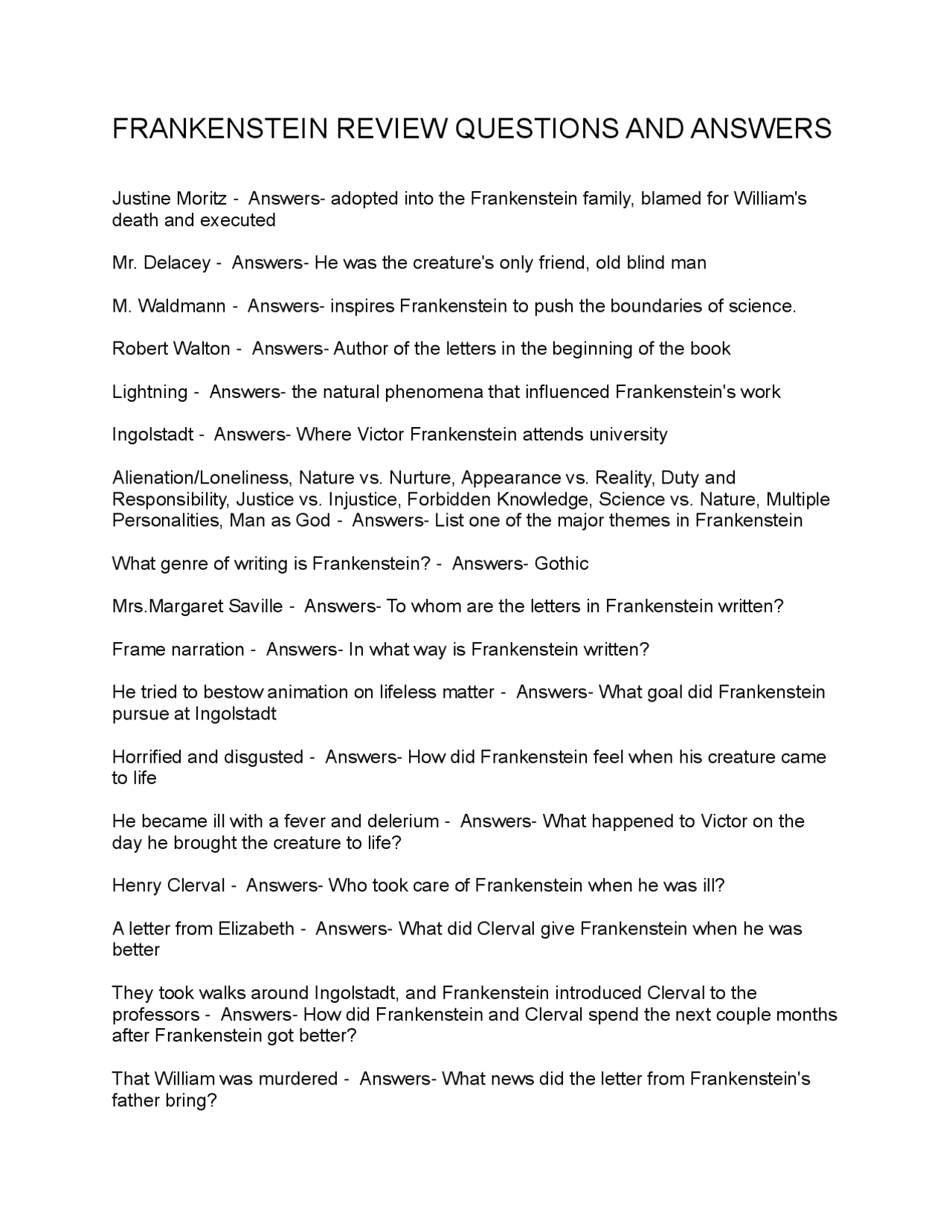
Chapter-by-Chapter Study Guide Questions and Answers
To assist with rigorous review, the following section addresses the most common study guide questions encountered in academic curricula.
Question 1: How does Robert Walton’s background establish the themes of the novel?
- Answer: Walton is an ambitious explorer driven by a desire to conquer the unknown and achieve immortal fame. His letters to his sister establish the dangers of isolation and obsessive ambition. By mirroring Victor’s psychological profile before the main narrative even begins, Walton frames the entire novel as a cautionary tale about the perils of overreaching human desire.
Question 2: What role do Cornelius Agrippa, Paracelsus, and modern science play in Victor’s downfall?
- Answer: In his youth, Victor reads archaic alchemical texts that promise mastery over nature. Later, at Ingolstadt, professors like Waldman introduce him to modern chemistry, which provides the technical foundation for his experiments. Victor’s downfall stems from his failure to integrate scientific knowledge with ethical wisdom, treating science as a tool for personal glory rather than a discipline requiring careful stewardship.
Question 3: Why does Victor abandon the Creature immediately after bringing him to life?
- Answer: Victor abandons the Creature due to an immediate, visceral reaction of horror and revulsion regarding his appearance—his watery eyes, yellow skin, and disproportionate features. This abandonment represents a moral failure; Victor acts as an irresponsible creator who shirks his duty of care, setting off the chain of tragedies that destroys his life.
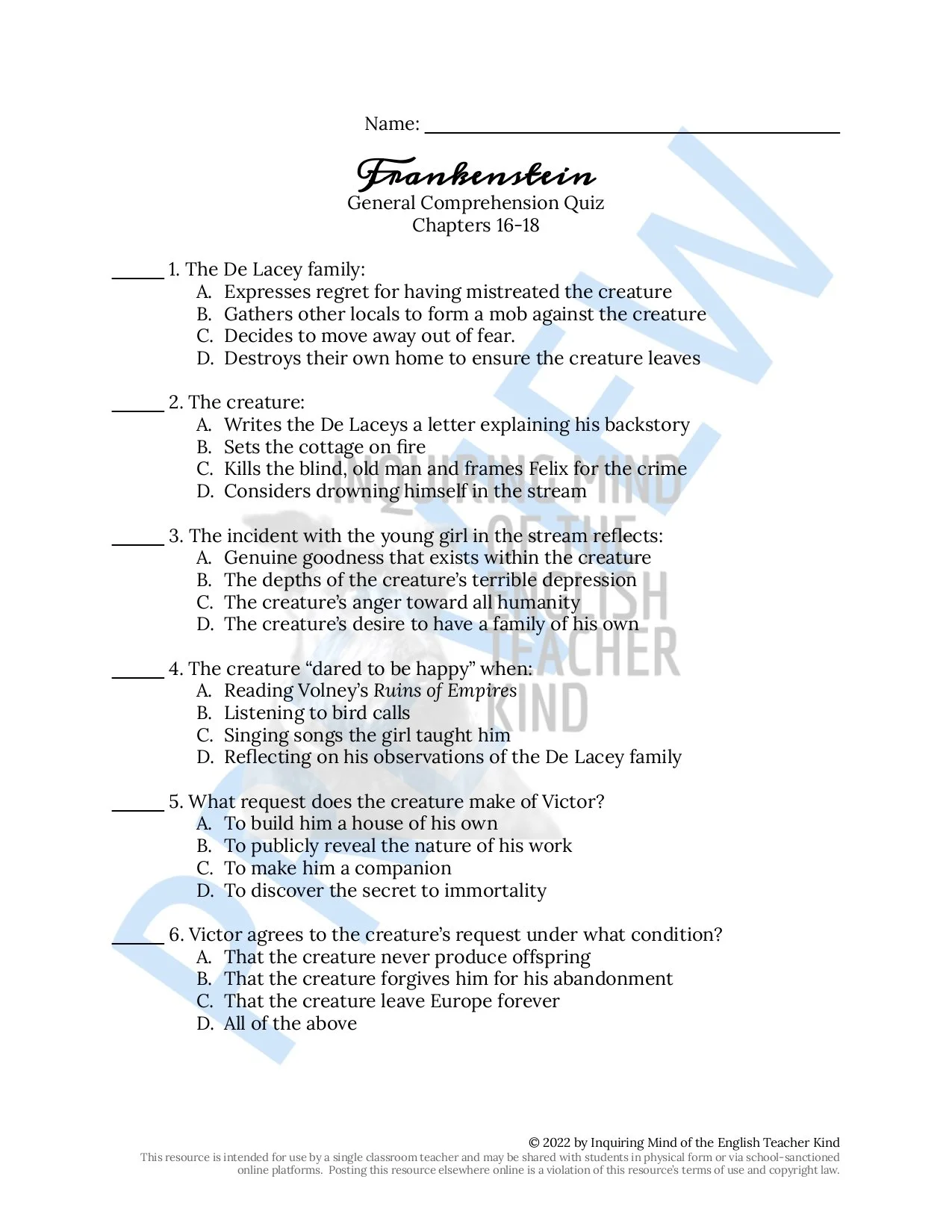
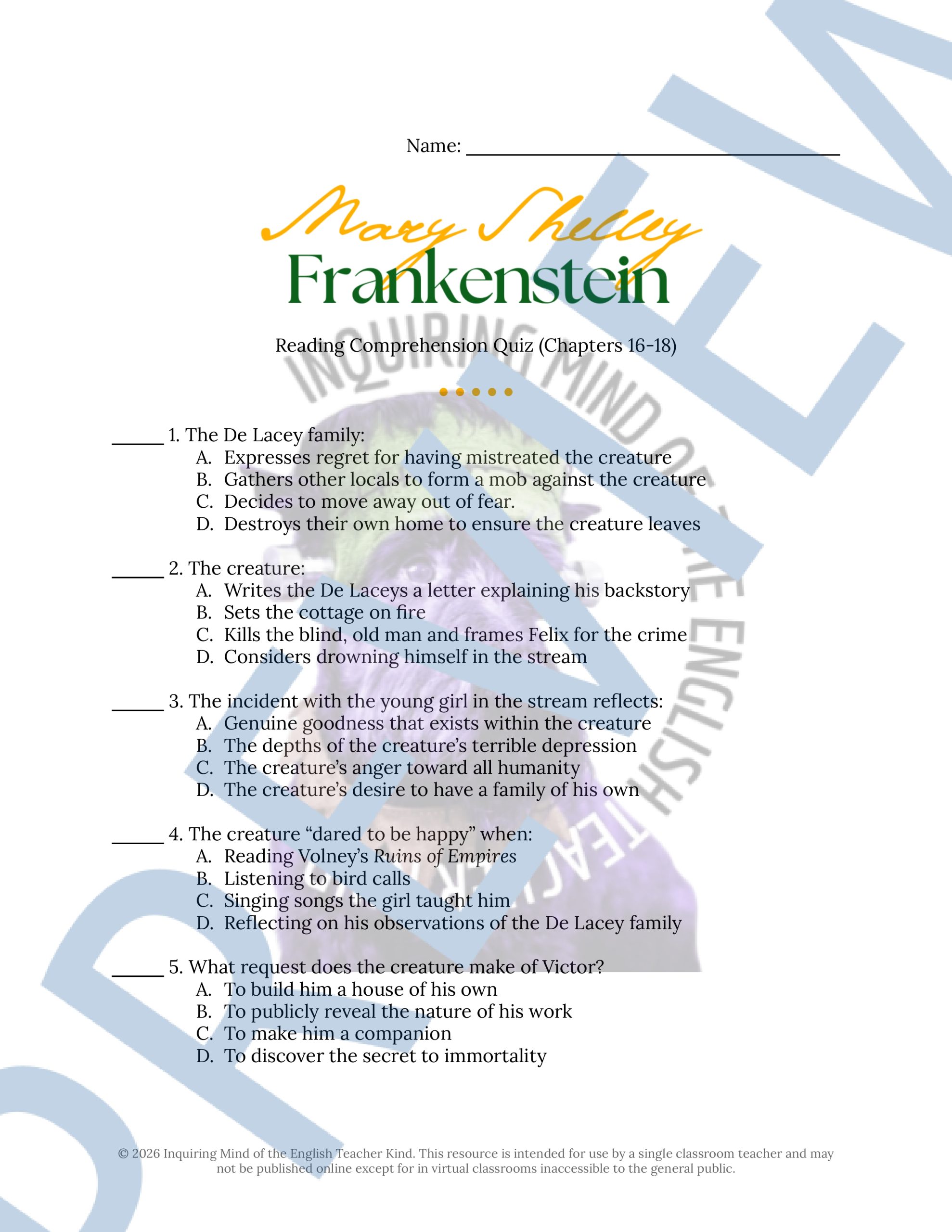
Question 4: How does the Creature educate himself while hiding near the De Lacey cottage?
- Answer: The Creature secretly observes the impoverished De Lacey family, learning language, social customs, and human emotion through their interactions. He also finds a lost bundle of books—including John Milton’s Paradise Lost, Johann Wolfgang von Goethe’s The Sorrows of Young Werther, and Plutarch’s Lives—which provide him with deep intellectual insight and a framework for understanding his own tragic alienation.
Question 5: What is the significance of the Creature’s demand for a female companion?
- Answer: The Creature argues that his violent actions are the direct result of his absolute loneliness. He promises that if Victor creates a female mate, they will retreat to the wilds of South America and live harmlessly away from human society. Victor initially agrees but destroys the half-finished female out of fear that they might reproduce and endanger the human race, sealing his own doom.
Comparative Literary Context
To fully understand Frankenstein, readers must examine how it fits into the broader literary movements of the early 19th century.
- Gothic Tradition: The novel utilizes classic gothic tropes—secret laboratories, midnight exhumations, desolate landscapes, stormy weather, and brooding villains. However, Shelley moves beyond mere horror to explore profound psychological and ethical dilemmas.
- Romanticism: Frankenstein engages deeply with Romantic ideals. The sublime beauty of the Swiss Alps, the Arctic ice, and the Orkney Islands reflects the emotional states of the characters. Nature is depicted as a healing, majestic force that contrasts sharply with the industrial, unnatural ambitions of Victor.
- Science Fiction Origins: Long before the term "science fiction" existed, Shelley established foundational tropes of the genre, including bioengineering, playing creator with technology, and the ethical fallout of unintended scientific consequences.
Common Mistakes and Misconceptions in Study Guides
When preparing answers for tests or essays, students often fall into specific analytical traps. Avoiding these errors ensures a higher level of critical accuracy.
- Calling the Monster "Frankenstein": A frequent error is referring to the Creature as "Frankenstein." Frankenstein is the surname of his creator, Victor. The Creature remains nameless throughout the novel, symbolizing his lack of identity and social standing.
- Assuming Victor is Blameless: Some superficial readers view Victor as an innocent victim of a malicious monster. A rigorous analysis recognizes that Victor's gross negligence, vanity, and failure to provide moral guidance to his creation make him co-responsible for the ensuing violence.
- Ignoring the Frame Narrative: Dismissing Walton’s letters as a mere introductory tool misses the structural symmetry of the novel. Walton's redemption at the end directly contrasts with Victor’s tragic end, framing the narrative as a lesson learned.
Frequently Asked Questions
What are the main themes of Mary Shelley’s Frankenstein?
The primary themes include the dangers of scientific hubris, the conflict between nature and nurture, the psychological toll of isolation, the definition of monstrosity, and the responsibilities of creators toward their creations. Shelley weaves these concepts through the parallel narratives of Victor and his creature.
Why did Mary Shelley write Frankenstein?
The novel originated during a famous ghost story competition in Switzerland in 1816, featuring Mary Shelley, Percy Bysshe Shelley, Lord Byron, and John Polidori. Inspired by a nightmare about a pale student of unhallowed arts kneeling beside the thing he had put together, Mary Shelley expanded the concept into a full-length novel exploring contemporary scientific experiments with galvanism.
How does the creature learn to speak and read?
The Creature learns language by secretly observing the De Lacey family in their cottage. He learns to read after discovering a leather satchel containing three seminal books: Milton’s Paradise Lost, Goethe’s The Sorrows of Young Werther, and Plutarch’s Lives, which profoundly shape his worldview and self-awareness.
Is Frankenstein considered the first science fiction novel?
Many literary historians and critics regard Frankenstein as the first true science fiction novel because it shifts the explanation of supernatural or terrifying events from magic and superstition to pseudo-scientific experimentation and natural philosophy.
What happens to Victor Frankenstein at the end of the novel?
After pursuing the Creature across the globe to the Arctic circle in a quest for revenge, Victor falls mortally ill and is rescued by Captain Robert Walton’s ship. He dies aboard the vessel before Walton's expedition can return to England, having exhausted his mind and body in his obsessive pursuit.
Practical Next Steps for Academic Study
To excel in analyzing Mary Shelley’s Frankenstein, readers should review the primary text with these study strategies in mind:
- Annotate Key Passages: Focus on descriptions of the natural sublime versus Victor’s indoor laboratories.
- Track Character Transformations: Trace how Victor shifts from an enthusiastic student to a paranoid fugitive, and how the Creature shifts from an innocent observer to a vengeful outcast.
- Draft Thematic Essays: Practice writing comparative essays examining how Walton, Victor, and the Creature each experience varying degrees of isolation and ambition.
Image Gallery
Select an image to open it in a new tab.