
When comparing New York Life insurance to an Indexed Universal Life (IUL) policy, you are looking at a fundamental debate between whole life insurance built on guaranteed, fixed dividends from a mutual company and an equity-indexed product tied to market performance with adjustable costs. Choosing between them requires understanding how their cash values grow, the level of risk you assume, and how each policy functions over decades.
Permanent life insurance serves as both a financial safety net for beneficiaries and a vehicle for accumulating cash value. However, the mechanism behind how that cash value grows and how premiums are structured differs vastly between a traditional mutual carrier like New York Life and an independent IUL provider. This comparison explores the mechanics, costs, risks, and long-term viability of both options to help you determine which structure aligns with your financial goals and risk tolerance.
Understanding the Foundation of Permanent Life Insurance
Before comparing specific product types, it helps to understand why individuals choose permanent life insurance over term life insurance. Permanent policies are designed to last your entire life, provided premiums are paid, and they include a savings component known as cash value. This cash value grows on a tax-deferred basis, meaning you do not pay taxes on the growth as long as it remains inside the policy. Policyholders can typically borrow against this cash value or make withdrawals to supplement retirement income, fund education, or manage emergencies.
However, not all permanent insurance is created equal. Traditional whole life insurance—the flagship product of mutual insurers like New York Life—emphasizes stability, contractual guarantees, and conservative predictability. On the other hand, Indexed Universal Life (IUL) is a form of universal life insurance that ties cash value crediting to the performance of an external stock market index, such as the S&P 500, while offering a minimum interest rate floor to protect against market downturns.
New York Life Insurance Overview: The Mutual Whole Life Approach
New York Life Insurance Company is one of the largest mutual life insurance companies in the United States. A mutual company is owned by its policyholders rather than outside shareholders. This corporate structure heavily influences the types of products they offer and how those products perform over time.
Guaranteed Growth and Fixed Premiums
The core of New York Life’s permanent portfolio is its whole life insurance policy. Whole life insurance features fixed, level premiums that will never increase as you age. The policy offers three main guarantees:
- A guaranteed death benefit that remains level or grows depending on the riders selected.
- A guaranteed rate of cash value accumulation, regardless of broader economic conditions.
- Premiums that are contractually locked in at the time of purchase.
Dividends and Mutual Ownership
Because New York Life is a mutual company, eligible policyholders may receive annual dividends. While dividends are never strictly guaranteed, New York Life has a long historical track record of paying dividends to eligible whole life policyholders every year since 1854. Policyholders can use these dividends to reduce out-of-pocket premium payments, purchase paid-up additions (which increase both the death benefit and cash value), accumulate cash interest, or receive them as a direct cash payout.

IUL Insurance Overview: Market-Linked Growth with Protection
Indexed Universal Life (IUL) insurance is a variation of universal life insurance introduced to provide higher potential growth than traditional whole life by tying interest crediting to stock market indices.
How IUL Cash Value Works
In an IUL policy, your cash value is not invested directly in the stock market. Instead, the insurance company uses options strategies or derivatives to track the performance of an index like the S&P 500.
- Caps and Participation Rates: Your upside earnings are typically limited by a "cap rate" (e.g., if the market gains 15% and your cap is 8%, you are credited 8%). Participation rates dictate what percentage of the index gain is applied.
- Floors: To protect against losses, IULs feature a "floor," usually set at 0%. If the market drops significantly, your cash value does not lose value due to negative market performance, though you may still pay internal policy fees and administrative costs.
Flexible Premiums and Adjustable Structures
Unlike whole life insurance, universal life policies like IUL offer flexibility. You can often adjust your premium payments within certain regulatory limits, raising or lowering payments depending on your cash flow. However, this flexibility requires careful management. If your cash value drops too low due to underfunding or rising internal costs, the policy can lapse, requiring a massive injection of capital to keep it active.
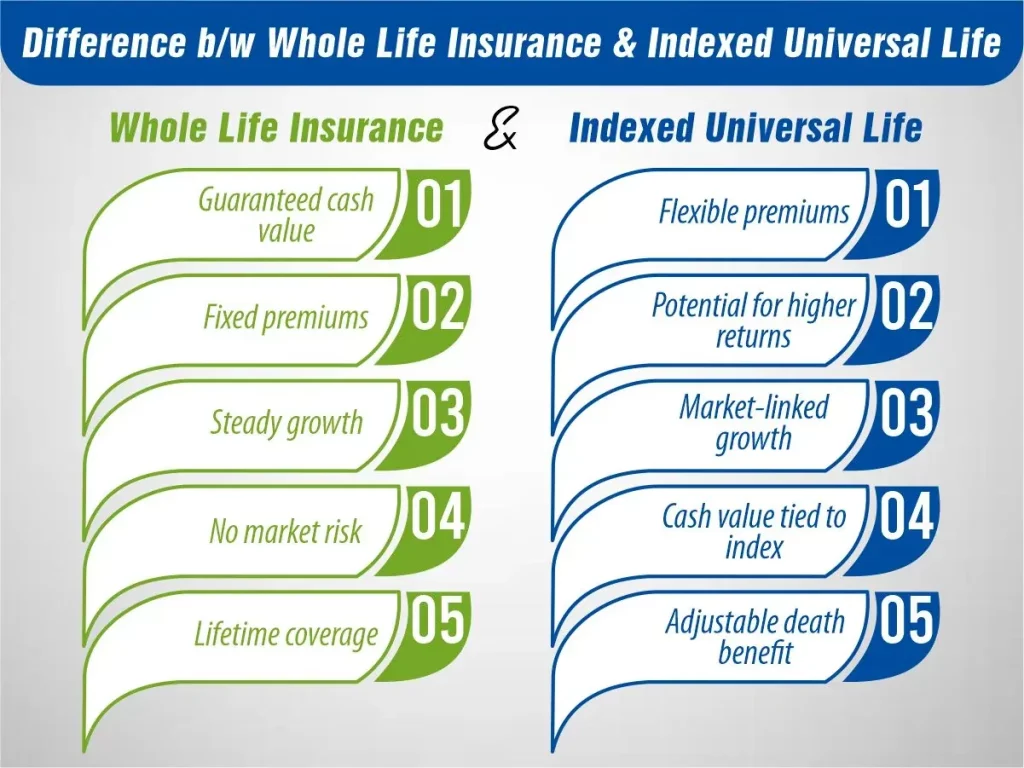
Key Differences: New York Life Whole Life vs. IUL
Evaluating these two options side-by-side reveals distinct differences in risk profiles, cost structures, and administrative maintenance.
| Feature | New York Life Whole Life | Indexed Universal Life (IUL) |
|---|---|---|
| Primary Insurer Type | Mutual company (policyholder-owned) | Stock or mutual companies |
| Premium Structure | Fixed and level for life | Flexible within policy guidelines |
| Cash Value Growth | Guaranteed base rate + variable dividends | Tied to market index with a 0% floor |
| Risk Profile | Low risk; highly predictable | Moderate risk; performance-dependent |
| Management Required | Low maintenance after purchase | High ongoing monitoring required |
| Cost Transparency | Generally bundled into the premium | Unbundled; cost of insurance rises with age |
Risk and Predictability
New York Life’s whole life is designed for risk-averse individuals who value certainty. You know precisely what your cash value will look like decades into the future based on contractual guarantees and historical dividend scales. IUL introduces variability. While a 0% floor prevents market crashes from wiping out your cash value principal, extended periods of low market returns or high volatility combined with rising internal fees can lead to underperformance relative to initial projections.
Cost of Insurance and Fees
With a traditional whole life policy from New York Life, the cost of insurance is amortized evenly across your expected lifespan within a fixed premium. With an IUL, the cost of insurance often increases as you grow older. If the index performance underperforms, the cash value may not grow fast enough to cover these escalating internal costs, forcing the policyholder to pay significantly higher out-of-pocket premiums later in life to prevent a policy lapse.
Evaluating Financial Objectives and Suitability
Determining whether New York Life whole life or an IUL is better depends entirely on your financial objectives, timeline, and personal tolerance for administrative oversight.
When New York Life Whole Life Fits Best
- Long-Term Estate Planning: Individuals seeking a guaranteed legacy for heirs or funding a buy-sell agreement for a business partner.
- Conservative Savers: Those who prefer contractual certainty over the possibility of higher, market-linked returns.
- Hands-Off Approach: Policyholders who want to set up a policy, pay a fixed premium, and not worry about monitoring annual index caps or participation rates.
When IUL Fits Best
- Aggressive Accumulation Focus: Individuals who have maxed out traditional retirement accounts (like 401ks and IRAs) and want tax-advantaged growth potential tied to equity markets without direct equity risk.
- Flexibility Seekers: Business owners or freelancers with fluctuating annual incomes who need the ability to adjust premium payment amounts.
- Active Managers: Policyholders willing to review annual statements, adjust funding strategies, and work closely with a financial professional to manage the policy over time.
Disclaimer: Life insurance products involve complex financial structures, underwriting criteria, and tax implications. Consult with an independent financial advisor, tax specialist, or insurance professional to evaluate your specific circumstances before purchasing a permanent life insurance policy.
Frequently Asked Questions
Is New York Life an IUL policy?
No. New York Life primarily offers traditional whole life insurance, term life, and universal life insurance, but it does not emphasize Indexed Universal Life products. New York Life focuses on mutual whole life insurance backed by its general account and annual dividend distributions rather than market-linked index crediting strategies.
Can I lose money in an IUL policy?
You typically do not lose cash value directly from negative market drops because IULs include a guaranteed floor (usually 0%). However, your cash value can still decrease in value due to the ongoing deduction of internal policy fees, administrative costs, and the rising cost of insurance as you age, especially if market returns remain flat or low for extended periods.
Why do some financial experts criticize IUL illustrations?
IUL illustrations often project cash value growth based on historical market averages with optimistic assumptions about caps and participation rates. If future market returns are lower than the illustrated rate—or if the insurance company lowers its cap rates—the actual cash value accumulation will fall significantly short of the initial sales projection.
Which policy is better for retirement income?
Both can provide tax-free retirement income through policy loans and withdrawals, but they do so differently. New York Life whole life offers stable, predictable dividend-backed income streams that are highly reliable. An IUL offers the potential for higher tax-free income if index performance is strong, but carries the risk of underperformance requiring higher out-of-pocket funding to sustain the income stream.
Are permanent life insurance dividends guaranteed?
No. While the guaranteed minimum interest rate on a whole life policy or the floor on an IUL is contractually guaranteed by the insurer, dividends paid by a mutual company like New York Life are never guaranteed. They are declared annually by the company's board of directors based on investment returns, mortality experience, and operational expenses.
Next Actions and Verification
Before committing to either a New York Life whole life policy or an IUL, request a formal, in-force ledger illustration from a licensed insurance agent. For IULs, ask the agent to run a conservative illustration showing a lower, flat interest rate (such as 4% or 5%) to see how the policy performs under adverse market conditions. For whole life, examine the historical dividend performance record of the carrier. Ensure that the death benefit and cash value projections align with your long-term estate planning or retirement income timeline.
Image Gallery
Select an image to open it in a new tab.


Owen Fletcher
Collegiate Life Correspondent
