Navigating Low Commission Brokers: Costs, Features, and Choosing the Right Platform

Low commission brokers have fundamentally transformed modern investing by drastically reducing the cost of executing trades across equities, options, and exchange-traded funds. These platforms typically charge minimal or zero fees per trade, making market participation accessible to a wider demographic of retail investors while prompting legacy institutions to overhaul their own pricing schedules.
Understanding Low Commission Brokers
The financial services industry has experienced a major structural shift toward low-cost and zero-fee trading models. For decades, traditional brokerages charged fixed per-trade commissions—often ranging from $10 to $30 or more—which significantly eroded the returns of frequent traders and small-balance portfolios alike. The emergence of online electronic brokerages changed this landscape by eliminating standard ticket charges for stock and exchange-traded fund (ETF) transactions.
Low commission brokers generate revenue through alternative channels rather than direct trading fees. Understanding these revenue streams is essential for evaluating whether a low-cost platform aligns with your financial strategy. Common monetization methods include:
- Payment for Order Flow (PFOF): Routing customer orders to specific market makers or high-frequency trading firms in exchange for a fraction of a cent per share.
- Net Interest Margin: Earning interest on uninvested cash balances sitting in brokerage accounts (often paying investors a lower interest rate than the broker collects from lending or holding cash).
- Margin Lending: Charging interest on loans extended to investors who borrow money to purchase securities.
- Account and Premium Services: Fees for specialized research reports, wire transfers, paper statements, or expedited settlements.
While these brokers drastically reduce transaction costs, investors must evaluate execution quality, platform stability, and ancillary fees to ensure that a "free" or low-cost trade does not result in a worse overall financial outcome due to unfavorable price execution.
Key Features to Evaluate Beyond Commissions
When selecting a brokerage, focusing exclusively on commission rates can be a critical mistake. A truly comprehensive evaluation requires analyzing several core operational and functional elements.
Execution Quality and Price Improvement
The stated commission rate tells only part of the story. Execution quality measures how efficiently a broker executes your order relative to the National Best Bid and Offer (NBBO) at the time the order is placed. Brokers that achieve high rates of price improvement save investors money by securing better purchase or sale prices than the prevailing market quote. Conversely, poor execution can cost more than a traditional commission fee.
Account Minimums and Tiered Pricing Structures
Many low commission brokers have eliminated account minimums, allowing investors to open accounts with nominal sums. However, certain platforms maintain tiered structures where advanced features, professional-grade market data, or lower margin rates require maintaining a higher account balance or paying a monthly subscription fee.
Tradable Asset Classes
Not all low-cost brokers support the same array of financial instruments. While almost all modern discount brokerages support US equities and ETFs, availability varies significantly for:
- Options contracts (which often carry small per-contract fees even on "commission-free" platforms).
- Futures and foreign exchange (Forex).
- Mutual funds (which may carry transaction fees or load charges depending on the fund family).
- Fixed-income products such as Treasury bonds, municipal bonds, and corporate debt.
Research, Tools, and Educational Resources
Active traders require sophisticated charting packages, technical indicators, and real-time data feeds. Long-term investors, on the other hand, benefit more from fundamental research reports, macroeconomic commentary, and portfolio analysis tools. Reviewing a platform's proprietary software or third-party integrations (such as desktop trading platforms) ensures you have the analytical capability required for your investment style.

Comparative Overview of Brokerage Fee Models
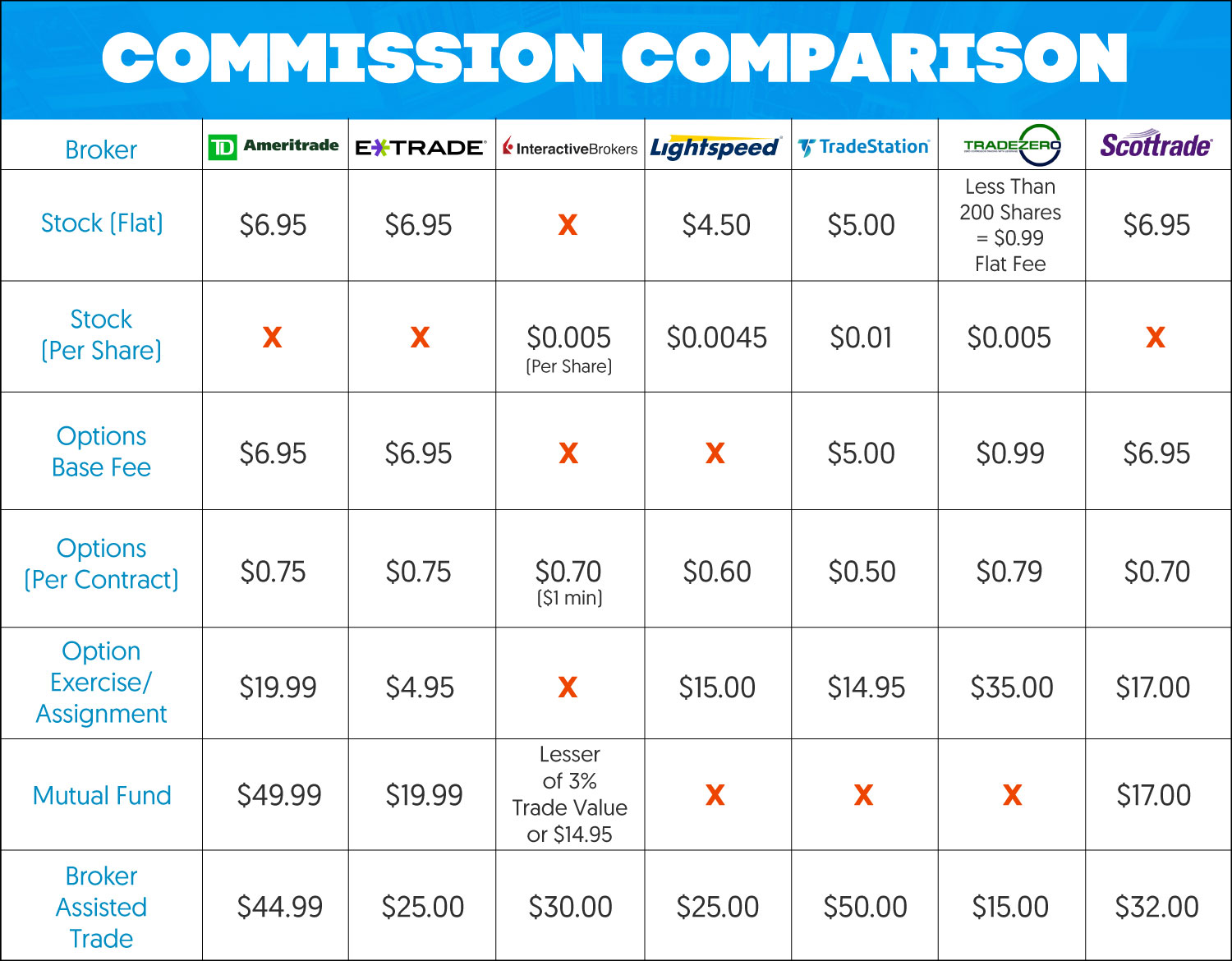
To illustrate how low commission brokers structure their offerings, the table below compares standard fee categories across typical discount brokerage configurations. Note that specific terms vary by provider and are subject to regulatory updates.
| Feature / Fee Category | Traditional Full-Service Broker | Standard Discount Broker | Specialized Trading Platform |
|---|---|---|---|
| Stock & ETF Commissions | $5.00 to $30.00+ per trade | $0.00 (Commission-free) | $0.00 for standard equities |
| Options Contracts | $1.00 to $2.00+ per contract | $0.50 to $0.65 per contract | Often discounted for high-volume traders |
| Account Minimums | $10,000 to $100,000+ | $0.00 | $0.00 to $2,000 |
| Margin Interest Rates | Higher variable rates | Moderate tiered rates | Competitive low rates for large balances |
| Inactivity Fees | Common on small balances | Generally none | May apply for specialized accounts |
Potential Hidden Costs and Trade-Offs
While eliminating trading commissions benefits the average investor, it introduces subtle trade-offs that require careful management. Recognizing these hidden costs helps prevent unexpected expenses.
1. Payment for Order Flow and Spread Costs
When a broker routes orders to market makers, the bid-ask spread—the difference between the highest price a buyer is willing to pay and the lowest price a seller is willing to accept—plays a vital role. If order routing prioritizes payment revenue over execution price, investors may experience wider effective spreads, offsetting the savings gained from zero-commission trading.
2. Cash Drag and Low Yields on Uninvested Cash
Many brokerages automatically sweep uninvested cash into low-yielding internal money market funds or deposit accounts while retaining a significant portion of the interest generated in the current macroeconomic environment. Investors holding substantial cash reserves should examine whether their broker offers competitive cash sweep yields or manually allocate cash to higher-yielding instruments like Treasury bills.
3. Ancillary Service Fees
While buying and selling shares is typically free, auxiliary actions can carry substantial fees. Common charges include:
- Outbound account transfer (ACATS) fees when moving assets to another institution.
- Wire transfer fees for deposits or withdrawals.
- Paper statement and trade confirmation fees.
- Corporate action processing fees for reorganizations or tender offers.
Regulatory Safeguards and Investor Protection
When depositing capital with any financial institution, verifying regulatory compliance and asset protection mechanisms is non-negotiable. In the United States, legitimate broker-dealers must be registered with the Securities and Exchange Commission (SEC) and maintain membership in the Financial Industry Regulatory Authority (FINRA).
Furthermore, investors should verify Securities Investor Protection Corporation (SIPC) membership. SIPC provides up to $500,000 in coverage per customer (including a $250,000 limit for cash claims) in the event of a brokerage firm's liquidation due to financial failure. It is important to note that SIPC protection does not guard against market losses or drops in asset value. Many brokers also carry private excess SIPC insurance to protect account balances far exceeding standard regulatory limits.
Disclaimer: This article is for informational and educational purposes only and does not constitute financial, legal, or professional advice. Financial markets involve risk, and investors should evaluate their personal risk tolerance or consult a qualified financial advisor before committing capital.
Frequently Asked Questions
How do low commission brokers make money if trades are free?
Low commission brokers generate revenue through alternative mechanisms, primarily payment for order flow (routing trades to wholesale market makers), collecting net interest margin on uninvested cash balances, charging interest on margin loans, and billing for optional premium services or specialized trading tools.
Are zero-commission trades truly free?
While the direct broker commission fee is $0 for most standard stock and ETF transactions, investors may still incur indirect costs. These include regulatory fees (such as small SEC transaction fees), options contract fees, wider bid-ask spreads resulting from order routing practices, and ancillary account service charges.
What is payment for order flow (PFOF)?
Payment for order flow is a practice where a brokerage routes its clients' buy and sell orders to third-party market makers for execution. In return, the market maker pays the broker a small fee per share or contract. This practice allows brokers to offer commission-free trading while transferring order execution to external liquidity providers.
How do I verify if a broker is legitimate and regulated?
You can verify a broker's regulatory status in the United States by checking the FINRA BrokerCheck database. This tool confirms whether the firm is properly registered, discloses its regulatory history, and verifies its SIPC membership status.
Do low commission brokers offer retirement accounts like IRAs?
Yes, most major low commission brokerages support tax-advantaged accounts, including Traditional IRAs, Roth IRAs, and rollover accounts, typically without charging annual account maintenance or custody fees.
Image Gallery
Select an image to open it in a new tab.


Nathaniel Ford
Systems and Electronics Editor
